






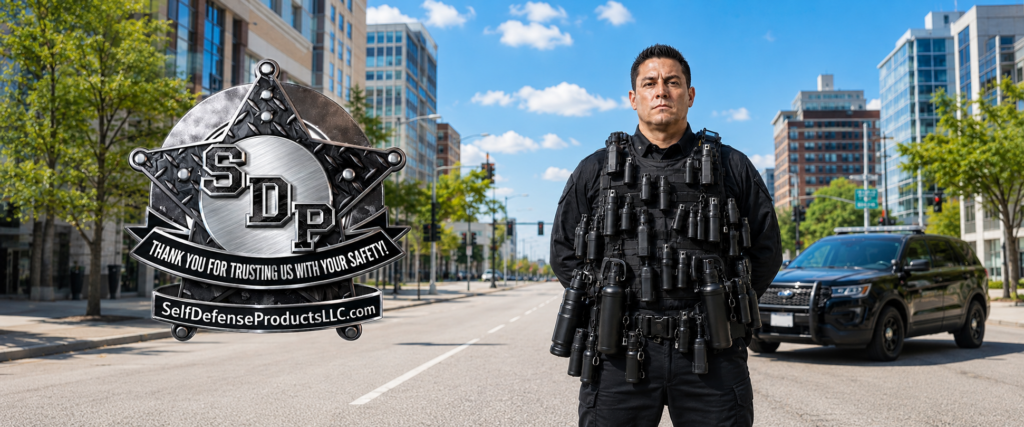
If you are wondering what brand of pepper spray police use, there is no one answer. Police departments do not all carry the same brand. Each department chooses the pepper spray that fits its rules, training, budget, and approved equipment list.
The more important question is not just which brand police carry. You also need to look at the formula, Major Capsaicinoids percentage, spray pattern, range, canister size, and your state laws.
Why Isn’t There One Official Police Pepper Spray Brand?
Police departments, sheriff’s offices, state patrol agencies, and federal agencies do not have one national pepper spray supplier. Each agency can approve its own equipment.
Many agencies also require officers to train with the exact type of spray they carry. An officer usually cannot buy any pepper spray and add it to a duty belt. The spray may need to match the department’s training and equipment rules.
A department may look at the formula, spray pattern, canister size, safety design, training requirements, price, and supply contract before choosing a product. That is why the answer can change from one department to another.
Mace Helped Start the History of Police Defense Spray
Mace has a long history connected to police work. The original Chemical Mace was developed in the 1960s. It used CN, which is a tear gas chemical. That original formula was different from the OC pepper spray most people know today.
Police agencies started using Chemical Mace as another option besides a gun or baton. Over time, the Mace name became so well known that people started using the word “mace” for many kinds of defense spray, even when the product was made by another company.
Mace later moved into OC pepper spray products. That history is why the Mace name is still closely tied to pepper spray today.
Why Did Police Start Carrying OC Pepper Spray?
Many police agencies started moving toward OC pepper spray in the early 1990s. OC stands for oleoresin capsicum. It comes from hot peppers.
OC spray can cause intense burning, heavy tearing, coughing, skin irritation, and involuntary eye closure. It creates an inflammatory response instead of depending only on pain.
Results can still vary from one person and situation to another. No pepper spray is guaranteed to stop every person.
What Brand of Pepper Spray Do Police Use?
There is no current independent list showing which brand every police department carries. Departments buy from several law enforcement suppliers. The approved brand may change when contracts, policies, or training programs change.
Claims such as “the number one police brand” or “the brand most trusted by police” are often marketing claims. They do not prove that most police departments carry that brand.
The best answer is that officers carry the brand and model approved by their department. That brand can be different from one department to the next.
What Law Enforcement Has Told Me About Pepper Spray
I have spoken with people in law enforcement, including police officers, plainclothes investigators, state patrol officers, and people from other law enforcement agencies. Many have told me that pepper spray is not always the first tool they want to use.
One of the main reasons is contamination. Pepper spray can drift through the air or spread inside a car, room, or other small space. It can get on the officer, the person being sprayed, and other people nearby. Officers do not want to spray themselves or expose people who were not involved.
After pepper spray is used, the person may need to be moved to fresh air and cleaned up. The spray must be washed from the face, eyes, skin, and clothing. The area may also need time to clear out.
Officers have told me that the person who was sprayed may be in severe pain, yelling, screaming, and saying they cannot see. The officer still has to control the scene while dealing with that person and keeping everyone else safe.
If the person says they need medical help or reports a serious problem, medical workers may need to be called. Depending on the department and situation, an ambulance may come to the scene. The person may also need to be checked at a hospital.
Police officers are not doctors. When someone reports a medical problem, officers may need to let trained medical workers check that person. That can add more time, paperwork, people, and resources to the call.
Officers have also told me that they may have backup and other approved tools available. A uniformed officer may have a baton, gun, Taser, handcuffs, and radio. Some would rather use another approved option than deal with pepper spray contamination and cleanup.
To the best of my knowledge, this depends on the officer, department, training, and situation. I am sharing what people in law enforcement have told me and what I have learned through my own experience. It does not apply to every officer or police department.
Why Do Some Officers Reach for a Taser First?
From what law enforcement officers have told me, some reach for a Taser first because they believe it can end the struggle faster without filling the air with pepper spray.
A Taser does not create the same type of airborne contamination. Officers do not have to wash pepper spray from themselves, other officers, a patrol car, or people standing nearby.
This can make the situation easier to manage after the person is under control. The officer may not have to spend as much time dealing with burning eyes, contaminated clothing, cleanup, and a person yelling that they cannot see.
A Taser still has risks. It may also lead to a medical check, depending on the person, department policy, and what happened. The difference is that it does not leave pepper spray in the air or on everyone nearby.
National research has also found that police use of pepper spray went down as Tasers became more common. This supports what many officers have personally told me.
This does not mean every officer reaches for a Taser first. It means some officers may choose it when they believe it will handle the situation faster and create less contamination afterward.
Why Pepper Spray Can Still Make Sense for Civilians
A police officer and a civilian are not in the same position. An officer may have a duty belt filled with tools, radio contact, training, and backup that can be called to the scene.
Most civilians do not have those options. Pepper spray may give you a way to create distance and get away without making physical contact with an attacker.
A civilian is also not trying to arrest someone, transport that person, complete police reports, or keep the person in custody. Your goal is to create a chance to escape and call 911.
That does not mean pepper spray will work every time. It means it may be a practical choice when you carry the right canister, know how it works, and can reach it quickly.
What Does Police Strength Pepper Spray Mean?
“Police strength” is not an official national strength rating. It is often marketing language.
A product labeled police strength may have a certain formula, range, canister size, spray pattern, safety design, or UV marking dye. The words alone do not tell you how hot or effective the spray will be.
A higher OC percentage does not automatically mean a hotter spray. OC percentage tells you how much pepper resin is in the formula. It does not tell you the exact heat of the finished spray.
Major Capsaicinoids, often shown as MC, gives you a better way to compare pepper spray strength. Our pepper spray safety guide explains how OC percentage, MC percentage, range, and spray patterns work.
Can Civilians Buy Strong Pepper Spray?
In many states, civilians can buy pepper spray in the same general strength range as products sold for law enforcement. Police pepper spray is not automatically hotter just because an officer carries it.
Our WildFire pepper spray products are listed at 1.4% MC. Our Pepper Shot products are listed at 1.2% MC. These are strong personal defense formulas available in different sizes and spray patterns.
This does not mean 1.4% MC is the highest strength allowed by one national law. There is no single nationwide 1.4% civilian limit. Some states have lower concentration or canister-size limits.
Always check the rules where you live before buying or carrying a spray. Our pepper spray laws by state guide can help you begin checking the current requirements.
What Matters More Than the Police Label?
Do not choose pepper spray only because the label says police strength. Look at the details that can affect how you carry and use it:
- Major Capsaicinoids percentage
- Stream, fogger, gel, or foam pattern
- Effective range
- Canister size
- Safety lock or flip-top design
- How quickly you can reach it
- Your state and local laws
The best choice is one you can legally carry, reach quickly, and use correctly.
Pepper Spray Is a Tool, Not a Guarantee
Pepper spray may give you time to get away from danger. It cannot promise that every attacker will stop.
Pay attention to your surroundings. Keep your distance when possible. Carry your spray where you can reach it. Learn how the safety works before an emergency happens.
If you ever need to use pepper spray, your goal should be to create distance, get to safety, and call 911.
Bottom Line
There is no single pepper spray brand carried by every police department. Each agency chooses its own approved equipment and trains its officers to use it.
People in law enforcement have told me that they may choose a Taser because pepper spray can contaminate officers, vehicles, rooms, and other people. They may also need to spend time cleaning the person, calling medical workers, arranging a hospital visit, and dealing with someone who is yelling or saying they cannot see.
That is based on what officers have told me and what I have learned through my own experience. It does not mean every officer or department handles pepper spray the same way.
For civilians, pepper spray may still be a practical choice because most people do not have a duty belt, radio, or trained backup. Focus on the MC percentage, spray pattern, range, canister size, and laws where you live. You can view our current pepper spray selection to compare the products we carry.
Common Questions About Police Pepper Spray
Does every police department use the same pepper spray brand?
No. Each department or agency can approve its own pepper spray, training, and equipment rules.
What brand of pepper spray do police carry?
Police departments buy from several law enforcement suppliers. There is no current independent nationwide list showing which brand every department carries.
Why do some officers use a Taser instead of pepper spray?
Some officers have said a Taser may end the struggle faster without spreading pepper spray through the air. Pepper spray can contaminate officers, vehicles, rooms, and other people. It can also lead to cleanup, medical calls, and more time spent managing the person who was sprayed.
Does pepper spray always require an ambulance?
No. An ambulance does not automatically come every time pepper spray is used. Medical workers may be called when the person reports a serious problem, asks for medical care, has trouble recovering, or when department policy requires it.
Is police strength pepper spray an official rating?
No. Police strength is not one official national standard. Check the Major Capsaicinoids percentage, spray pattern, range, and canister details instead of trusting those words alone.
Can civilians buy pepper spray as strong as police spray?
In many states, yes. Civilians may be able to buy formulas in the same strength range as products marketed to law enforcement. State restrictions can still limit strength, size, purchase, or possession.
Does a higher OC percentage make pepper spray stronger?
Not automatically. OC percentage measures the amount of pepper resin in the formula. Major Capsaicinoids percentage gives you a better measurement of the finished spray’s heat.
Was original Mace the same as today’s pepper spray?
No. Original Chemical Mace used CN tear gas. Modern Mace Brand products include OC pepper spray formulas, which are different from the original Chemical Mace formula.

